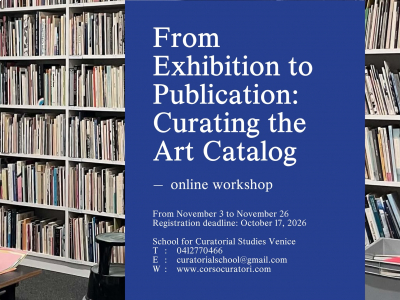
From Exhibition to Publication: Curating the Art Catalog
Type
Curatorial Proposal
Category
Curating
Status
Open for Applications
Deadline
October 17, 2026
Application Fee
$565.05
Host
CURATORIAL SCHOOL VENICE
Location
Milan, Italy
Online Workshop
From November 3 to November 26,
Registration deadline: October 17, 2026
Creating and structuring an art catalog is a process that requires attention to detail, specific knowledge, and a clear overall vision of the artistic project. The course aims to provide all the essential elements needed to produce the publication accompanying an exhibition, examining the various phases and professional figures involved in its creation. This is a delicate process with numerous facets that the workshop presents and analyzes to offer the appropriate skills for tackling editorial work in public or private institutions. The solid tools provided enable participants to develop the ability to handle the practical aspects this work requires. The program emphasizes learning through practice and includes various exercises and research assignments to be presented in class. Participants are given the necessary tools to operate professionally in the art world, specifically in the publishing field.The course includes a final project in which each participant will structure a catalog conceived, designed, and built in its entirety.
SUBJECTS OF STUDY
Analysis of the figures involved in producing an editorial product
Editorial planning: content
Budget structuring; bibliographic research and document drafting
Sourcing photographic material
Working with the artist (if living) or copyright holders
Proofreading; collaboration with various professionals such as editors, translation agencies, and graphic teams
Practical exercises to be completed at home and presented in class: online bibliographic research; analyzing reliable websites; writing bibliographies for monographic books; creating an artist chronology; photographic material and captions
TUTOR
Tommaso Speretta is an independent curator and art book editor. He holds a PhD in Practice in Curating from the University of the Arts Zurich and the University of Reading. His professional and academic background spans curating, art book editing, writing, and teaching, forming the core of a practice that brings theory and curatorial work into dialogue. He has curated exhibitions in international contexts, including the Henie Onstad Kunstsenter in Oslo, and has collaborated with the Venice Biennale. He has also worked with the Deste Foundation in Athens on the 2000 Words book series and has contributed to various exhibition catalogs and artist books. He teaches Visual Culture at Boston University and Curatorial Practice at IUAV University in Venice. He is co-founder of the independent space Camera Doppia in Milan.
COURSE DETAILS
Duration: 16 hours
Format: Online, 2 hours per day
Schedule: 2 days per week for 4weeks
Start date: Tuesday, November 3, 2026
Time: 6:00 PM – 8:00 PM, every Tuesday and Thursday
Recordings provided for missed sessions
Certificate issued upon completion by the School for Curatorial Studies Venice
Registration: Submit the registration form and CV to aurora@curatorialstudiesvenice.org by October 17 2026
Transform your perspective into practice. Reserve your place in the curator's lab today!
APPLICATION FORM
Credits: The course is valid for requesting educational credits (number determined by individual universities)
SESSION SCHEDULE
SESSION 1 – Tuesday, November 3, 2026 (6:00–8:00 PM)
Introduction to the Art Catalog
What is an art catalog and who is it for?
Differences between general catalog, monographic catalog, and exhibition catalog
The catalog's role in enhancing the artist, collection, and curatorial research
Case studies: analysis of major catalogs (Venice Biennale, Fondazione Prada, museum catalogs)
Assignment: Bring an example of a catalog and discuss its strengths/weaknesses
SESSION 2 – Thursday, November 5, 2026 (6:00–8:00 PM)
Editorial Planning
Choosing the format (print, digital, hybrid)
Typical structure: introduction, critical essays, artwork entries, appendices (biography, bibliography)
Selecting textual content (critical texts, interviews, technical notes)
SESSION 3 – Tuesday, November 10, 2026 (6:00–8:00 PM)
Structure and Content of the Catalog
Organizing sections logically
Writing effective artwork entries (title, artist, year, dimensions, techniques, description)
Writing artist biographies and profiles
Role and drafting of introduction and preface
Exercise: Create a draft table of contents for a fictional catalog
SESSION 4 – Thursday, November 12, 2026 (6:00–8:00 PM)
Design and Layout
Graphic design principles for art catalogs
Layout and pagination based on content and audience
Material and printing choices: paper types, catalog format, binding, digital vs. offset printing
SESSION 5 – Tuesday, November 17, 2026 (6:00–8:00 PM)
Editing and Revision
Spelling, grammar, and stylistic consistency checks
Image editing: correction and optimization of artwork photographs
Final coherence and quality verification
SESSION 6 – Thursday, November 19, 2026 (6:00–8:00 PM)
Image Management and Legal Aspects
Art photography: resolution, color, usage rights
Organizing images (logical sequence, comparisons, details)
Basic software for editing (Photoshop) and layout (InDesign)
Copyright management and legal aspects of reproducing artworks
Digital cataloging: software and online platforms
SESSION 7 – Tuesday, November 24, 2026 (6:00–8:00 PM)
Distribution and Marketing
Distribution strategies: how and where to distribute the catalog
Promotion: using media and digital platforms
Organizing presentations and launch events
Review of participants' individual work with corrections
SESSION 8 – Thursday, November 26, 2026 (6:00–8:00 PM)
Final Project Presentation
Presentation and discussion of the final project (structuring a complete catalog)
From November 3 to November 26,
Registration deadline: October 17, 2026
Creating and structuring an art catalog is a process that requires attention to detail, specific knowledge, and a clear overall vision of the artistic project. The course aims to provide all the essential elements needed to produce the publication accompanying an exhibition, examining the various phases and professional figures involved in its creation. This is a delicate process with numerous facets that the workshop presents and analyzes to offer the appropriate skills for tackling editorial work in public or private institutions. The solid tools provided enable participants to develop the ability to handle the practical aspects this work requires. The program emphasizes learning through practice and includes various exercises and research assignments to be presented in class. Participants are given the necessary tools to operate professionally in the art world, specifically in the publishing field.The course includes a final project in which each participant will structure a catalog conceived, designed, and built in its entirety.
SUBJECTS OF STUDY
Analysis of the figures involved in producing an editorial product
Editorial planning: content
Budget structuring; bibliographic research and document drafting
Sourcing photographic material
Working with the artist (if living) or copyright holders
Proofreading; collaboration with various professionals such as editors, translation agencies, and graphic teams
Practical exercises to be completed at home and presented in class: online bibliographic research; analyzing reliable websites; writing bibliographies for monographic books; creating an artist chronology; photographic material and captions
TUTOR
Tommaso Speretta is an independent curator and art book editor. He holds a PhD in Practice in Curating from the University of the Arts Zurich and the University of Reading. His professional and academic background spans curating, art book editing, writing, and teaching, forming the core of a practice that brings theory and curatorial work into dialogue. He has curated exhibitions in international contexts, including the Henie Onstad Kunstsenter in Oslo, and has collaborated with the Venice Biennale. He has also worked with the Deste Foundation in Athens on the 2000 Words book series and has contributed to various exhibition catalogs and artist books. He teaches Visual Culture at Boston University and Curatorial Practice at IUAV University in Venice. He is co-founder of the independent space Camera Doppia in Milan.
COURSE DETAILS
Duration: 16 hours
Format: Online, 2 hours per day
Schedule: 2 days per week for 4weeks
Start date: Tuesday, November 3, 2026
Time: 6:00 PM – 8:00 PM, every Tuesday and Thursday
Recordings provided for missed sessions
Certificate issued upon completion by the School for Curatorial Studies Venice
Registration: Submit the registration form and CV to aurora@curatorialstudiesvenice.org by October 17 2026
Transform your perspective into practice. Reserve your place in the curator's lab today!
APPLICATION FORM
Credits: The course is valid for requesting educational credits (number determined by individual universities)
SESSION SCHEDULE
SESSION 1 – Tuesday, November 3, 2026 (6:00–8:00 PM)
Introduction to the Art Catalog
What is an art catalog and who is it for?
Differences between general catalog, monographic catalog, and exhibition catalog
The catalog's role in enhancing the artist, collection, and curatorial research
Case studies: analysis of major catalogs (Venice Biennale, Fondazione Prada, museum catalogs)
Assignment: Bring an example of a catalog and discuss its strengths/weaknesses
SESSION 2 – Thursday, November 5, 2026 (6:00–8:00 PM)
Editorial Planning
Choosing the format (print, digital, hybrid)
Typical structure: introduction, critical essays, artwork entries, appendices (biography, bibliography)
Selecting textual content (critical texts, interviews, technical notes)
SESSION 3 – Tuesday, November 10, 2026 (6:00–8:00 PM)
Structure and Content of the Catalog
Organizing sections logically
Writing effective artwork entries (title, artist, year, dimensions, techniques, description)
Writing artist biographies and profiles
Role and drafting of introduction and preface
Exercise: Create a draft table of contents for a fictional catalog
SESSION 4 – Thursday, November 12, 2026 (6:00–8:00 PM)
Design and Layout
Graphic design principles for art catalogs
Layout and pagination based on content and audience
Material and printing choices: paper types, catalog format, binding, digital vs. offset printing
SESSION 5 – Tuesday, November 17, 2026 (6:00–8:00 PM)
Editing and Revision
Spelling, grammar, and stylistic consistency checks
Image editing: correction and optimization of artwork photographs
Final coherence and quality verification
SESSION 6 – Thursday, November 19, 2026 (6:00–8:00 PM)
Image Management and Legal Aspects
Art photography: resolution, color, usage rights
Organizing images (logical sequence, comparisons, details)
Basic software for editing (Photoshop) and layout (InDesign)
Copyright management and legal aspects of reproducing artworks
Digital cataloging: software and online platforms
SESSION 7 – Tuesday, November 24, 2026 (6:00–8:00 PM)
Distribution and Marketing
Distribution strategies: how and where to distribute the catalog
Promotion: using media and digital platforms
Organizing presentations and launch events
Review of participants' individual work with corrections
SESSION 8 – Thursday, November 26, 2026 (6:00–8:00 PM)
Final Project Presentation
Presentation and discussion of the final project (structuring a complete catalog)