Exhibition Proposals for outdoor gallery
Type
Curatorial Proposal, Exhibition
Category
Curating, Design, Installation
Status
Archived
Deadline
January 31, 2023
Application Fee
Free
Host
FLOUNDER LEE
Location
New York, United States
Exhibition Proposals
Pennant Place
www.pennantplace.art
Eligibility
Open to all artists, curators, and collectives worldwide except current undergraduate students.
Individuals who identify as part of a historically marginalized group are encouraged to submit.
Theme
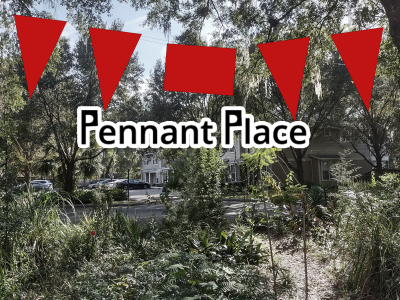
Seeking exhibition proposals from solo artists, collectives, and curators for a new outdoor space, Pennant Place, located in Gainesville, Florida. Work must be able to be hung on a cable about 13 feet (4m) off the ground and must be able to withstand the elements (wind, rain, sunshine, squirrels). Flags, Banners, Clothing, Streamers, Pennants, and Windchimes come to mind, but feel free to surprise us! Total exhibition weight shouldn’t exceed 40 pounds (18kg). There is about 32 feet (9.5m) of cable space for hanging work.
How to Submit Your Work
Proposals should be submitted as one PDF and include the following:
• Image of the proposed work (if the work is to be made, then example work)
• Captions
• Written proposal (~350-600 words)
• Optional: visual layout
• Artist(s)/Curator(s) Bio (~200-500 words each)
• CV(s) (up to 6 pages)
• Social Media Handles
• Contact Information
All submissions are currently reviewed on a rolling basis. Email submissions and any questions to:
flags@pennantplace.art
There are no submission or participation fees, but no artists fees or compensation is available. Shipping will likely be paid one direction by the artist and one direction by the gallery, but do not let shipping keep you from submitting, we can try and work on a plan if that is the limiting factor. Work will be outdoors and hung 13 feet off the ground in a quiet residential neighborhood but damage is possible and the space has no insurance for artwork and is not liable for any damage to work. Work will be insured during shipping.
Artwork sales are permitted with 80% going to the artists and 20% to the gallery. Any after-show sales or sales derived from the show of other artwork goes 100% to the artist.
Review and Selection
Artists will be contacted on a rolling basis as well. By submitting your work, you agree that images, videos, and/or text of your work can be used for promotional purposes, but you retain the original copyright.
Gallery Director Biography
Flounder Lee is an artist/curator and postgraduate researcher in Art & Media at the University of Plymouth, UK pursuing his PhD in art and curatorial practice, although he is based in Florida, USA on the stolen lands of the Timucua and Seminole. He was raised on the ancestral lands of the Yuchi, Shawnee, Muscogee/Creek, and Cherokee peoples in Alabama. He received his BFA from the University of Florida and his MFA from California State University Long Beach—both in studio art and photography. He then taught full-time at universities in the US, Malaysia, and Dubai for 12+ years.
Exhibitions curated include: The Future is…Ordinary? at the Shangyuan Art Museum, Beijing, China; On this night, for the first time, something will happen… at the Jean Paul Najar Foundation, Dubai, and Aerospacial at Herron School of Art and Design in Indianapolis. He founded and co-ran SpaceCamp MicroGallery, a tiny project space in Indianapolis. He has written several essays including for Tribe: Photography and New Media in the Arab World.
Several overlapping themes run throughout his work: decolonialism, mapping, science, the future, and environmental change. He uses various media such as photo, video, performance, sound, and installation to create work that touches on these topics.
His PhD project deals with mundane speculative futures through artistic and curatorial perspectives. He works using anti-oppressive practices—anti-racist, anti-colonial, anti-patriarchal, anti-heteronormative, anti-ableist, inclusive, and intersectional with decolonial and curatorial activism approaches.
www.flounderlee.com
Details of PhD
There is a potential for this exhibition to be part of Flounder’s PhD Project, and a separate information sheet and consent form will be sent to accepted participants if this is the case. No personal data will be used from non-participants. An agreement as to this will follow, if necessary. Not all shows at Pennant Place will be part of the Phd and having an exhibition does not require you to be part of the PhD project.
What is my PhD project about?
My practice-research PhD project examines the overlap, differences, and intricacies between a wide range of current contemporary art practices that deal with mundane futures. I define mundane futures as ones dealing with the ordinary, everyday, between extremes of utopia and dystopia, but not necessarily boring, in other words one that most of us will most likely experience. Through developing an intertwined art and curatorial practice, I plan to investigate these looks at everyday futures that are more just and more sustainable. I’m interested in how art practices can imagine and forge these possibilities. Within these potential futures, I’m focusing on two core subthemes: technology and survivance. Survivance is a concept established by Anishinaabe cultural theorist Gerald Vizenor that goes beyond mere survival into actively creating thriving communities that are also integral to the world outside of their communities. While trying to find my place in helping co-create realities that are more just, I will work at finding ways of using practice to become an accomplice (more involved than an ally) in the struggle against injustice and oppression.
My work is about putting artists and artworks focused on mundane futures into conversation with one another. It is the outcome of a process of curatorial methods that I am developing called the Mycelial Model of Curating. This is based on building relationships and curatorial activism. The 4 Rs of Indigenous curatorial work form the basis for my mycelial model—Respect, Reciprocity, Responsibility, and Relationships. Care is baked into all my actions; it forms part of each of the Rs. I respect the cultures, protocols, feedback, advice, and work of all the others before me, working presently and who come after me. The Mycelial Model’s goal is to connect and support artists, curators, and other creatives in the way that mycelial networks connect and support their companion plants and each other. Ethical, curatorial activism, as defined by Dr. Maura Reilly, is the path I plan to follow for the curatorial portions of my practice-research project. Reilly asks in what way curators can contribute to the work of making the art world more inclusive.
Pennant Place
www.pennantplace.art
Eligibility
Open to all artists, curators, and collectives worldwide except current undergraduate students.
Individuals who identify as part of a historically marginalized group are encouraged to submit.
Theme
Seeking exhibition proposals from solo artists, collectives, and curators for a new outdoor space, Pennant Place, located in Gainesville, Florida. Work must be able to be hung on a cable about 13 feet (4m) off the ground and must be able to withstand the elements (wind, rain, sunshine, squirrels). Flags, Banners, Clothing, Streamers, Pennants, and Windchimes come to mind, but feel free to surprise us! Total exhibition weight shouldn’t exceed 40 pounds (18kg). There is about 32 feet (9.5m) of cable space for hanging work.
How to Submit Your Work
Proposals should be submitted as one PDF and include the following:
• Image of the proposed work (if the work is to be made, then example work)
• Captions
• Written proposal (~350-600 words)
• Optional: visual layout
• Artist(s)/Curator(s) Bio (~200-500 words each)
• CV(s) (up to 6 pages)
• Social Media Handles
• Contact Information
All submissions are currently reviewed on a rolling basis. Email submissions and any questions to:
flags@pennantplace.art
There are no submission or participation fees, but no artists fees or compensation is available. Shipping will likely be paid one direction by the artist and one direction by the gallery, but do not let shipping keep you from submitting, we can try and work on a plan if that is the limiting factor. Work will be outdoors and hung 13 feet off the ground in a quiet residential neighborhood but damage is possible and the space has no insurance for artwork and is not liable for any damage to work. Work will be insured during shipping.
Artwork sales are permitted with 80% going to the artists and 20% to the gallery. Any after-show sales or sales derived from the show of other artwork goes 100% to the artist.
Review and Selection
Artists will be contacted on a rolling basis as well. By submitting your work, you agree that images, videos, and/or text of your work can be used for promotional purposes, but you retain the original copyright.
Gallery Director Biography
Flounder Lee is an artist/curator and postgraduate researcher in Art & Media at the University of Plymouth, UK pursuing his PhD in art and curatorial practice, although he is based in Florida, USA on the stolen lands of the Timucua and Seminole. He was raised on the ancestral lands of the Yuchi, Shawnee, Muscogee/Creek, and Cherokee peoples in Alabama. He received his BFA from the University of Florida and his MFA from California State University Long Beach—both in studio art and photography. He then taught full-time at universities in the US, Malaysia, and Dubai for 12+ years.
Exhibitions curated include: The Future is…Ordinary? at the Shangyuan Art Museum, Beijing, China; On this night, for the first time, something will happen… at the Jean Paul Najar Foundation, Dubai, and Aerospacial at Herron School of Art and Design in Indianapolis. He founded and co-ran SpaceCamp MicroGallery, a tiny project space in Indianapolis. He has written several essays including for Tribe: Photography and New Media in the Arab World.
Several overlapping themes run throughout his work: decolonialism, mapping, science, the future, and environmental change. He uses various media such as photo, video, performance, sound, and installation to create work that touches on these topics.
His PhD project deals with mundane speculative futures through artistic and curatorial perspectives. He works using anti-oppressive practices—anti-racist, anti-colonial, anti-patriarchal, anti-heteronormative, anti-ableist, inclusive, and intersectional with decolonial and curatorial activism approaches.
www.flounderlee.com
Details of PhD
There is a potential for this exhibition to be part of Flounder’s PhD Project, and a separate information sheet and consent form will be sent to accepted participants if this is the case. No personal data will be used from non-participants. An agreement as to this will follow, if necessary. Not all shows at Pennant Place will be part of the Phd and having an exhibition does not require you to be part of the PhD project.
What is my PhD project about?
My practice-research PhD project examines the overlap, differences, and intricacies between a wide range of current contemporary art practices that deal with mundane futures. I define mundane futures as ones dealing with the ordinary, everyday, between extremes of utopia and dystopia, but not necessarily boring, in other words one that most of us will most likely experience. Through developing an intertwined art and curatorial practice, I plan to investigate these looks at everyday futures that are more just and more sustainable. I’m interested in how art practices can imagine and forge these possibilities. Within these potential futures, I’m focusing on two core subthemes: technology and survivance. Survivance is a concept established by Anishinaabe cultural theorist Gerald Vizenor that goes beyond mere survival into actively creating thriving communities that are also integral to the world outside of their communities. While trying to find my place in helping co-create realities that are more just, I will work at finding ways of using practice to become an accomplice (more involved than an ally) in the struggle against injustice and oppression.
My work is about putting artists and artworks focused on mundane futures into conversation with one another. It is the outcome of a process of curatorial methods that I am developing called the Mycelial Model of Curating. This is based on building relationships and curatorial activism. The 4 Rs of Indigenous curatorial work form the basis for my mycelial model—Respect, Reciprocity, Responsibility, and Relationships. Care is baked into all my actions; it forms part of each of the Rs. I respect the cultures, protocols, feedback, advice, and work of all the others before me, working presently and who come after me. The Mycelial Model’s goal is to connect and support artists, curators, and other creatives in the way that mycelial networks connect and support their companion plants and each other. Ethical, curatorial activism, as defined by Dr. Maura Reilly, is the path I plan to follow for the curatorial portions of my practice-research project. Reilly asks in what way curators can contribute to the work of making the art world more inclusive.